
Commercial & Industrial Well Drilling
Engineered high-capacity water systems for manufacturing plants, cotton gins, feedlots, oilfield facilities, and municipal utilities across Lubbock and the South Plains. Built to strict TCEQ and HPWD engineering standards.
Public drinking water and industrial compliance standards.
Geophysical borehole logging and strata assessment.
Heavy-gauge stainless wire-wrapped screens for maximum yield.
Submit Plans or Request an Engineering Borehole Bid
Direct project manager routing: upload your RFP documents or call for an immediate site feasibility consultation. We offer a fast-response guarantee for commercial water outages.
Commercial RFP & Bid Request
Submit engineering specifications, flow targets, and facility location for commercial borehole procurement.
High-Volume Industrial Demands on the South Plains
Supplying a commercial cotton gin in Idalou or an active oilfield service hub in Levelland requires massive, uninterrupted daily water flow directly from the Ogallala or Dockum formations. A sudden drop in line pressure at an East Lubbock industrial manufacturing plant or a Slaton rail yard halts operations entirely, costing thousands of dollars per hour in lost production. Commercial well drilling Lubbock operations demand structural over-engineering. We install high-yield industrial water wells designed strictly to withstand continuous 24-hour extraction cycles, intense lateral soil pressures, and highly abrasive subsurface environments. As leading commercial water well contractors West Texas facility managers rely on, we execute heavy mud rotary drilling operations engineered explicitly for the heavy industrial sector.
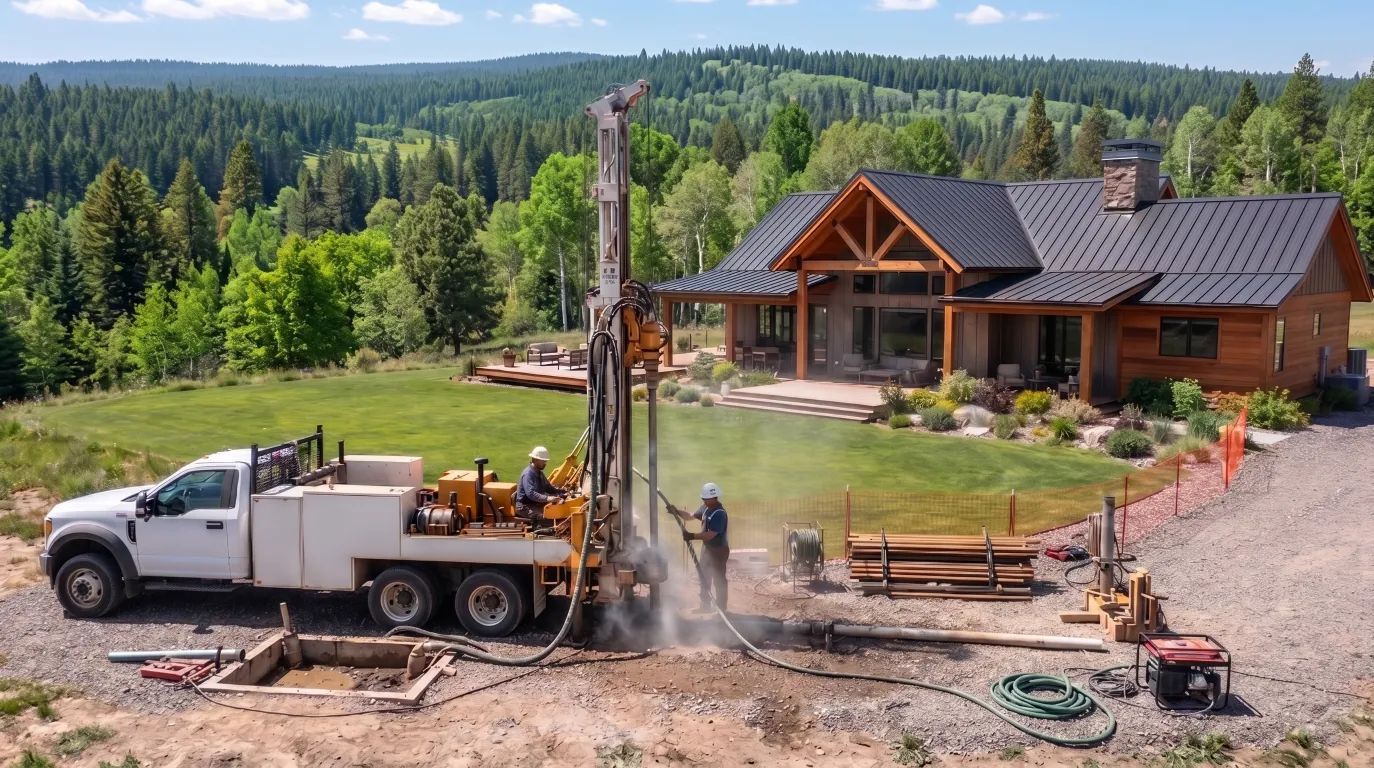
Drilling a 16-inch or 24-inch diameter borehole through the unconsolidated sands of the South Plains requires absolute control over downhole hydrostatic pressure. If the fluid column inside the hole drops, the loose sand walls will instantly collapse, burying the drill string and destroying the bore. We utilize heavy, truck-mounted mud rotary rigs equipped with massive displacement mud pumps. Our fluid engineers formulate highly specific bentonite clay and long-chain polymer drilling muds. This dense fluid creates a positive hydrostatic head against the raw formation, holding the sand walls open while effectively carrying heavy bedrock cuttings to the surface shale shakers.
Before we commit a massive steel casing string to the hole, we must verify the exact location of the productive water-bearing zones. We deploy advanced downhole geophysical logging tools into the open borehole. By running an electronic sonde down the fluid column, we record the electrical resistivity, spontaneous potential, and natural gamma radiation of the surrounding rock. This wireline logging identifies the precise depth and thickness of the saturated gravels versus the impermeable clay layers, allowing us to perfectly position the intake screens for maximum commercial yield.
Heavy Steel Casing and Continuous Wire-Wrapped Screens
Industrial water wells require rigid, indestructible materials. We entirely bypass PVC in our heavy commercial builds, utilizing exclusively large-diameter 10-inch to 16-inch heavy-wall steel casing. The sheer weight of a 500-foot steel string is immense. Our rig operators hoist each joint into the derrick, bevel the edges, and execute multi-pass stick welding to fuse the connections. We run a deep penetrating 6010 root pass followed by a low-hydrogen 7018 cap pass. This continuous welding process ensures the massive steel column maintains perfect vertical plumb and structural integrity while suspended in the drilling mud.
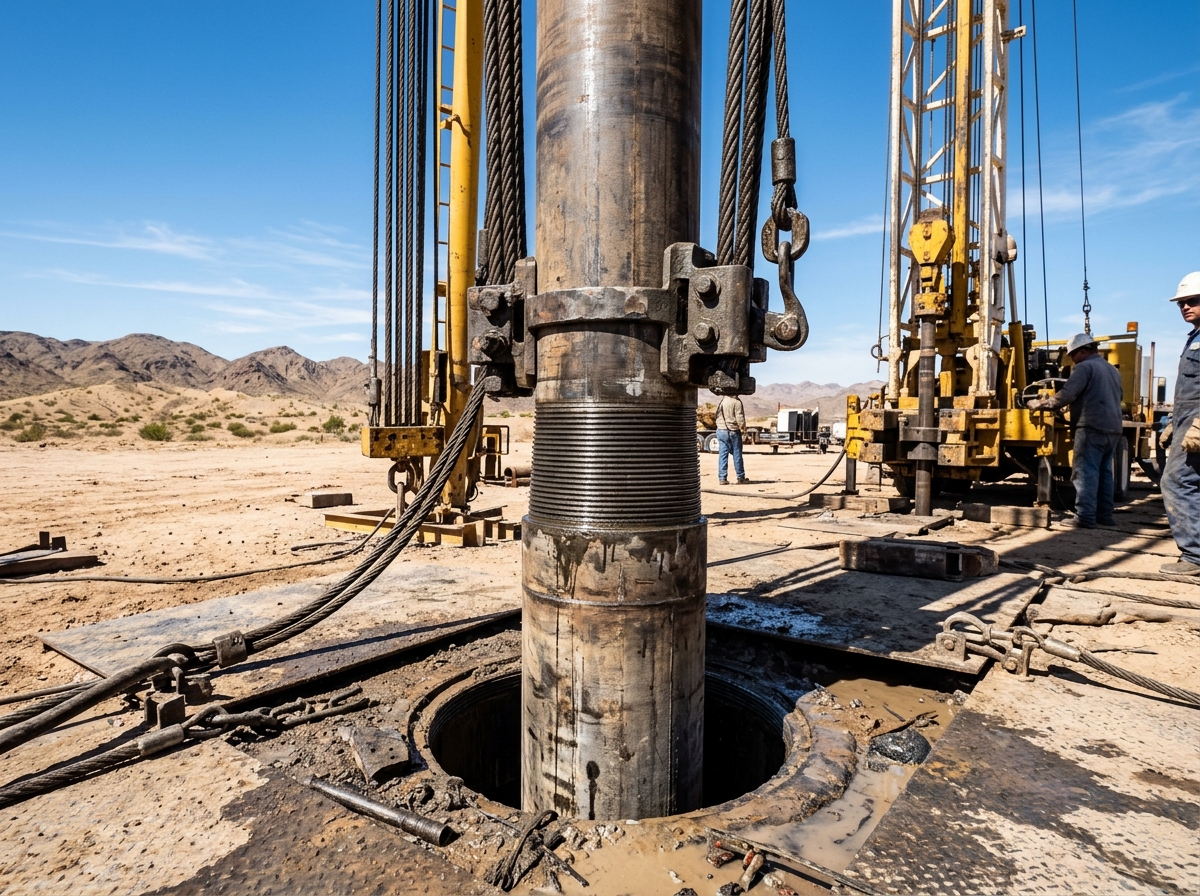
To maximize the extraction of groundwater from the aquifer, standard mill-slotted pipe is insufficient for industrial applications. We install continuous wire-wrapped screens across the productive sand zones identified by our geophysical logs. Wire-wrapped screens feature a V-shaped profile wire continuously welded around a structural internal ribbed frame.
This design provides significantly more open area than factory-slotted pipe, drastically reducing the entrance velocity of the water.
The V-shaped wire creates an inward-widening slot. If a sand grain passes the outer edge, it continues straight through rather than wedging in the gap, preventing the screen from blinding off during heavy pumping.
We match the exact slot size of the wire-wrapped screen to a custom-graded silica gravel pack, which we pump down the annulus to permanently stabilize the formation and filter out fine silt before it reaches your expensive turbine pumps.
Sanitary Seal Pressure Cementing to Bedrock
Commercial facilities and municipal well drilling projects must adhere to strict Texas Commission on Environmental Quality (TCEQ) public water supply standards. To prevent surface contaminants, industrial chemical spills, or shallow biological hazards from channeling down the outside of the casing and poisoning the aquifer, we execute heavy annular pressure cementing.
We run a rigid steel tremie pipe down the open annular space between the dirt wall and the steel casing, landing the pipe directly on the solid bedrock floor. Using high-pressure grout pumps, we force hundreds of sacks of neat cement or high-solids bentonite grout down the tremie pipe. Pumping from the absolute bottom up forces all drilling mud and standing water out of the top of the well. This process forms a massive, impenetrable concrete jacket around the upper casing, permanently sealing the well off from the surface environment.
Test Pumping and Aquifer Yield Verification
Before an industrial plant can size its water treatment equipment, the exact yield and drawdown characteristics of the new well must be proven mathematically. We conduct rigorous test pumping for aquifer yield verification using temporary, high-horsepower test pumps.
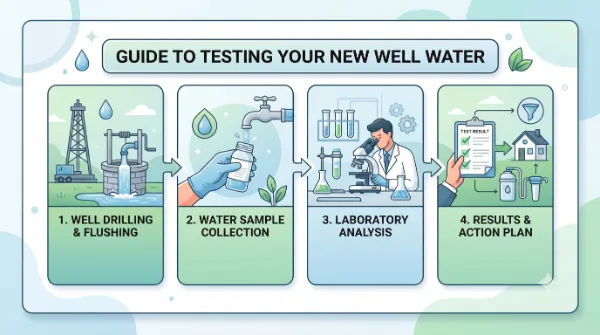
We run the pump at incrementally increasing flow rates (e.g., 200 GPM, 400 GPM, 600 GPM), holding each step for several hours. We measure the exact drop in the static water level inside the casing at each speed. This calculates the well's specific capacity and identifies the point at which the pump begins to outpace the aquifer's natural recharge rate.
For municipal and heavy commercial systems, we frequently execute 24-hour or 48-hour continuous constant rate tests. We pump the well at a high, sustained volume without stopping, monitoring the stabilization of the drawdown curve. This proves the long-term viability of the water source under extreme industrial demand.
Environmental Monitoring and Geothermal Operations
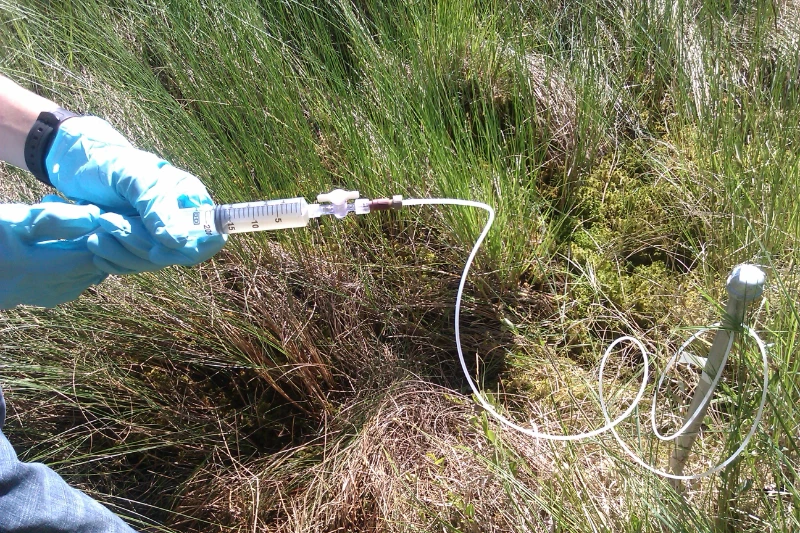
Beyond high-capacity supply wells, we construct specialized environmental monitoring wells around chemical storage facilities, bulk fuel depots, and landfill sites across the region. These 2-inch or 4-inch PVC systems are drilled precisely to the top of the water table. They allow environmental engineers to extract localized groundwater samples and monitor the static water level for potential contamination plumes. Our drilling crews are highly trained in decontamination protocols to ensure no cross-contamination occurs between monitoring bores.
We also handle large-scale commercial geothermal drilling Lubbock facilities require for advanced HVAC systems. Commercial closed-loop geothermal fields require dozens, sometimes hundreds, of closely spaced boreholes drilled to depths of 300 to 500 feet. We run the high-density polyethylene (HDPE) U-bend loops down these holes and execute strict thermally-enhanced pressure grouting. This specialized bentonite grout transfers the ground's natural temperature directly into the fluid loops, providing massive energy savings for large office buildings, schools, and medical facilities.
Fast-Response Commercial Outage Remediation
When a primary industrial well fails, the financial clock starts ticking instantly. A seized 100-horsepower submersible pump or a shattered vertical line-shaft turbine requires immediate heavy equipment mobilization. We maintain a fast-response guarantee for commercial outages across the South Plains.
Our fleet includes massive pump hoist rigs capable of pulling 40,000 pounds of water-laden steel drop pipe out of deep commercial boreholes. We stock industrial three-phase Franklin Electric control panels, massive soft-start drives, and heavy-duty contactors to resolve electrical failures immediately on-site. If the downhole pump is destroyed, we pull the string, diagnose the mechanical failure point, and lower a new industrial-grade Goulds or Grundfos turbine back into the water column. We do not let commercial facilities sit dry.
Submit Plans or Request an Engineering Borehole Bid
Direct project manager dispatch for industrial RFPs, municipal specifications, step-drawdown testing, and fast-response facility outages.