
Well Deepening & Rehabilitation
Is your water well sucking air, pumping silt, or dropping flow rate? We deepen existing boreholes into the Santa Rosa and Dockum sandstones and mechanically rehabilitate clogged casings with high-pressure air jetting across Lubbock County.
Re-drilling past depleted sands into deep Dockum bedrock.
High-CFM reverse circulation to clear iron bacteria & silt.
Casing patches and pressure grouting across ruptured zones.
Evaluate Deepening vs. Drilling a New Borehole
Please have your current well depth, static water level, pump age, and symptom checklist (air bursts, low pressure, sediment) ready for our engineering team.
Evaluate Well Deepening
Submit your current borehole depth, static water symptoms, and location for on-site downhole diagnostics.
Faucets Spitting Air: The Reality of Ogallala Depletion
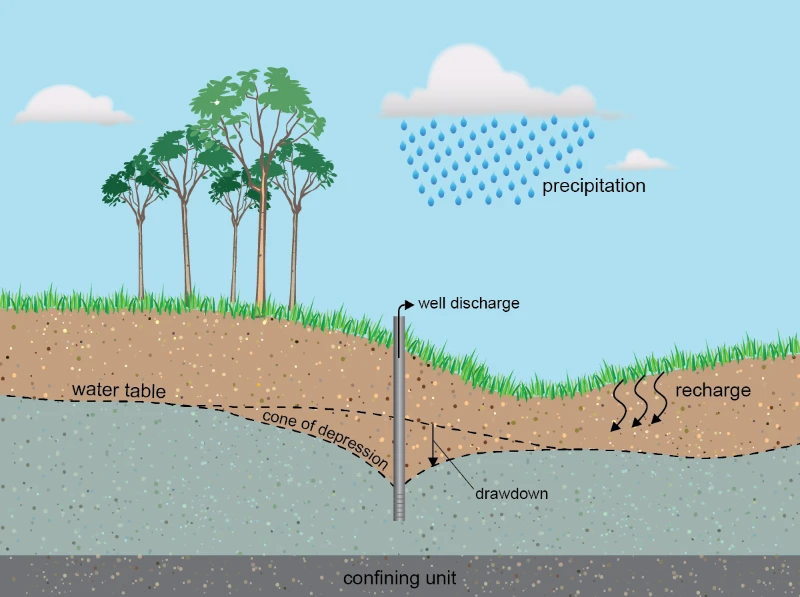
When your kitchen faucet violently spits bursts of compressed air followed by a surge of heavy, brown, sediment-laden water, your downhole pump is starved of intake volume. Across the South Plains, specifically in heavily pumped agricultural zones near Tahoka, Abernathy, and Post, dropping static water levels are systematically stranding submersible pumps high and dry. The Ogallala Aquifer is experiencing severe localized depletion trends, with annual water table drop rates consistently measuring between -0.57 to -0.90 feet per year in heavily impacted grid sectors.
As the regional water table falls, the cone of depression immediately surrounding your wellhead drops below the physical placement of your pump intake screen. The motor begins sucking oxygen alongside raw dirt. This rapidly causes extreme cavitation inside the wet end, systematically destroying the thermoplastic impellers while simultaneously burning up the copper motor windings due to a lack of cooling water flow. Simply lowering the pump on an extra joint of drop pipe is a temporary, and often impossible, band-aid if your borehole is already bottomed out against the underlying caprock. Resolving a dry well permanently requires heavy rotary equipment to either ream and deepen the existing casing or execute a mechanical well cleanout service to clear collapsed sand bridges that are choking off your inflow.
Evaluating a failing system requires exact downhole diagnostics. Before mounting the drill rig, we sound the casing with a sonic water level meter to determine your exact static head and total remaining water column. We check for massive sediment accumulation at the bottom of the PVC string. If your well was originally drilled to 150 feet but our tag line hits solid mud at 120 feet, decades of fine sand migration have buried your lower screens. In these instances, mechanical well rehabilitation is the immediate workflow. If the total depth is clear but the aquifer itself has receded below the bedrock floor, aggressive well deepening Lubbock TX contractors must pivot to targeting deeper geological formations.
Well Deepening: Punching Through the Triassic Red Beds
When the Ogallala formation completely dries out on your specific tract, the only vertical direction remaining is downward into the underlying Triassic rock layers. Drilling beneath the Ogallala requires heavy, high-torque mud rotary equipment capable of punching straight through the massive shelf of Triassic red bed clay. This sticky, dense, non-water-bearing clay layer forms the solid floor of the Ogallala Aquifer. Penetrating it requires specific drag bits and high-pressure mud circulation to prevent the heavy red clay from balling up around the drill string and locking the bit in the hole.
Beneath this massive clay aquitard lies the Dockum Aquifer, heavily utilized across the South Plains and frequently referred to as the Santa Rosa formation. Santa Rosa well drilling represents a totally different hydrogeological workflow compared to shallow Ogallala bores. The Dockum is a confined, deep sandstone aquifer. Reaching the productive saturated zones often requires pushing the total borehole depth to 300, 400, or even 500 feet, depending strictly on your surface elevation in Lubbock County.
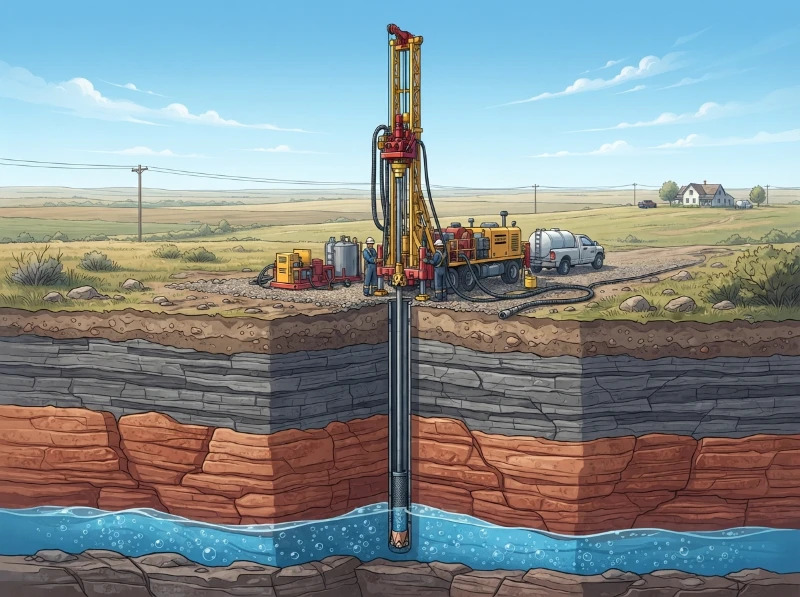
Deepening an existing well into the Dockum requires us to first verify the structural integrity of your existing upper casing. We cannot run heavy drill pipe and spinning bits through brittle, 40-year-old thin-wall PVC without shattering the pipe walls. If the existing upper casing is heavily compromised or undersized, we must abandon the old dry hole and spud a completely new, large-diameter borehole nearby, properly engineering the entire casing string to handle the extreme depths and pressures associated with the Dockum formation.
Legal Mandates: Preventing Aquifer Commingling
Drilling through the Ogallala and down into the Dockum Aquifer triggers intense state regulatory oversight. The Texas Department of Licensing and Regulation (TDLR) strictly prohibits the commingling of distinct groundwater formations. The Ogallala generally contains high-quality, fresh water, while the deeper Dockum (Santa Rosa) formation frequently produces brackish, highly mineralized, and naturally saline water depending on the specific fault block. If a driller simply punches a hole straight through both formations with a single, unsealed casing string, the distinct pressure differentials will force the poor-quality saline Dockum water upward, permanently contaminating the remaining fresh water in the Ogallala zones above.
To legally execute Dockum aquifer deepening, we must install heavily engineered isolation casing and execute precise pressure grouting workflows.
We first drill a massive oversized borehole down through the dying Ogallala layer and at least 20 feet into the solid Triassic red bed clay.
We land a heavy, solid steel or Schedule 80 PVC outer casing string directly into this clay shelf.
We run a rigid 1-inch tremie pipe down the outside of this casing all the way to the clay floor. Using a heavy mud pump, we force high-solids sodium bentonite grout or neat cement down the tremie pipe, filling the annular space from the absolute bottom back up to the surface.
Once the grout fully cures, the Ogallala is permanently sealed off behind a solid wall of cement. We then run a smaller drill bit directly down the center of this cemented casing, drill through the clay floor, and continue downward into the Santa Rosa sandstone.
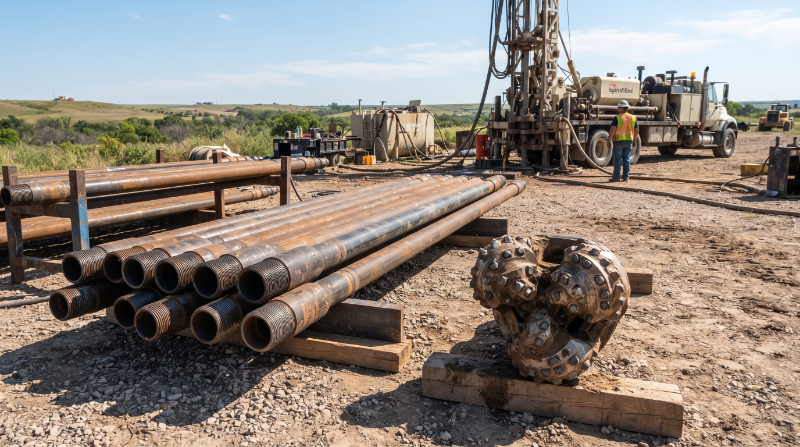
This mechanical isolation process is non-negotiable. It protects the regional water supply from heavy salt intrusion and ensures your new deep well system complies with all state laws and High Plains Underground Water Conservation District (HPWD) spacing rules.
Mechanical Well Rehabilitation and Air Jetting
A well producing low pressure or continuously pumping sand does not always require a massive deepening operation. Many older residential and agricultural wells simply suffer from extreme mechanical blockages within the gravel pack or the factory screen slots. Decades of continuous water extraction pull massive amounts of fine silica, iron bacteria, and calcium carbonate directly against the casing intake zones. Over time, these minerals petrify, completely blinding off the screen slots and starving the pump of water, artificially mimicking a dry well scenario.
Our well cleanout service utilizes aggressive downhole rehabilitation techniques to strip these blockages and restore your original GPM yield. The most common and effective mechanical process is high-pressure air jetting. We mobilize a heavy truck-mounted 185 CFM industrial air compressor to the wellhead. After pulling the submersible pump out of the hole, we lower a heavy-wall steel airline deep into the static water column, directly adjacent to the clogged casing screens.
We rapidly introduce massive volumes of compressed air into the casing. This creates violent, concussive pressure waves that forcefully blast outward through the screen slots, fracturing the mineral scale and shifting the surrounding gravel pack. We cycle the air pressure continuously, turning the water column into a violently boiling slurry. This surging action lifts decades of accumulated silt, heavy sand bridges, and chunks of iron bacteria directly up the casing and blows it out onto the ground. We continue airlifting the well until the discharge runs perfectly clear, verifying the natural aquifer pathways are fully reopened.
For severe iron bacteria infestations—which present as thick, slimy red sludge coating your pump and drop pipe—we utilize targeted downhole chemical surging. We pour concentrated liquid well-cleaning acids and heavy biocides into the casing. We then use a physical surge block on a wireline, forcefully plunging it up and down the water column to physically drive the acid deep into the gravel pack. We let the acid dwell, dissolving the bacterial biomass and hard mineral scale, before entirely pumping the neutralized sludge out of the system.
Structural Liner Sleeve Installations
If a mechanical cleanout reveals that an old galvanized or thin-wall PVC casing is physically cracked, shattered, or severely rusted out, the well will continuously dump raw dirt into the water column until the entire hole collapses. If the outer casing is structurally failing but the borehole itself is still straight and viable, we execute a liner sleeve installation to salvage the infrastructure.
This entails measuring the exact depth of the casing rupture using a downhole camera or physical tag line. We then build a smaller-diameter PVC string on the surface—for example, dropping a 4-inch liner directly inside a compromised 6-inch casing. At the top and bottom of the compromised zone, we install heavy rubber K-packers on the outside of the new liner. As we lower the liner into place, these flexible rubber flanges aggressively bite into the inner wall of the original casing, creating a waterproof, mechanical seal above and below the hole. This bypasses the structural failure entirely, isolating the incoming sand and allowing us to hang a new submersible pump safely inside the fresh inner sleeve. This is a highly technical, fast-turnaround alternative to completely re-drilling a compromised domestic well.
Schedule Downhole Depth & Static Head Diagnostics
Talk to our drilling crews about sonic water level sounding, air-jet cleanout services, or deep Santa Rosa re-drilling.